The Meter That Barely Moved
2026-08-27draft — publish-gated on ethics clearance
Draft 1 — 2026-08-27. Companion to “The Great AI Price Collapse Is Over.”
Publish-gated on ethics clearance. Numbers trace to
dataset/price_changes.csv via scripts/analysis_output_ratio.py; the
audit table is dataset/output_ratio_series.csv.
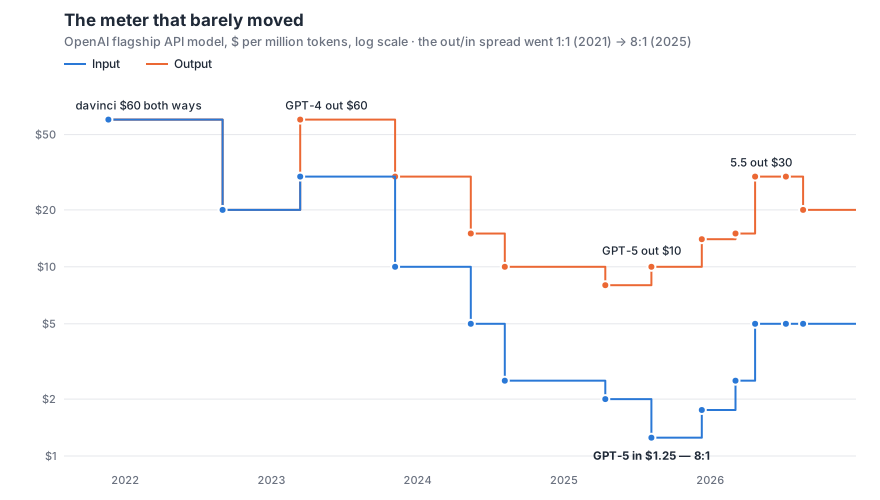
Every AI price headline you’ve read was about input tokens. “GPT-5 at $1.25 a million!” — that’s the input price. It’s the number providers cut, the number press releases lead with, the number that fell 97.9% in four years and became shorthand for intelligence is getting free.
Your bill runs on a different meter. And that one has been strangely, persistently sticky.
Two lines, one widening gap
In 2021, davinci charged $60 per million tokens in both directions — prompt and completion, one price. Then the two meters came apart:
| In | Out | Ratio | |
|---|---|---|---|
| davinci (2021) | $60 | $60 | 1:1 |
| GPT-4 (2023) | $30 | $60 | 2:1 |
| GPT-4 Turbo (2023) | $10 | $30 | 3:1 |
| GPT-4o (2024) | $5 | $15 | 3:1 |
| GPT-4.1 (2025) | $2 | $8 | 4:1 |
| GPT-5 (2025) | $1.25 | $10 | 8:1 |
| GPT-5.5 (2026) | $5 | $30 | 6:1 |
| GPT-5.6 (Aug 2026) | $5 | $20 | 4:1 |
While the advertised meter collapsed 97.9%, the output meter’s best price ever was GPT-4.1’s $8 — a fall of 86.7%, and it didn’t stay there. Compare three years honestly: GPT-4’s output cost $60 in March 2023; GPT-5.5’s cost $30 in April 2026. The tokens the model produces got exactly 2× cheaper in three years — over a period when the input meter got 6× cheaper and the industry narrative said costs were in free fall.
Why the sticky meter is the one that matters now
The ratio didn’t drift to 8:1 by accident. It widened precisely as the industry pivoted to reasoning models — models that think in output tokens. A chat reply is a few hundred output tokens; a reasoning trace can run tens of thousands, billed at the output rate, mostly invisible to the user. (Consumption figures are illustrative context, not ledger data — the ledger speaks to prices, and the prices alone make the case.)
Look at what providers did with their reasoning lines: o1-preview launched in late 2024 at $60 output — GPT-4’s 2023 price, reintroduced under a new meter, eighteen months of “deflation” later. Anthropic never even pretended: Claude Opus has sat at $15 in / $75 out — a 5:1 ratio — for two and a half years across three model generations, the stickiest price in the entire ledger.
So the honest accounting of the AI cost story is: the meter everyone watches was cut to nearly nothing while usage shifted onto the meter that was quietly repriced upward — first by ratio (1:1 → 8:1), then, since mid-2025, in absolute terms too ($8 → $30 at the flagship, before August’s trim to $20).
What to do with this
If you buy tokens: evaluate models on blended cost for your mix, and assume your mix is more output-heavy than you think if you’re using reasoning modes. An “8× cheaper” flagship with an 8:1 ratio can bill like its predecessor. The input price is marketing; the ratio is the business model.
If you watch this market: the ratio is now a leading indicator. A widening ratio is a provider shifting margin onto reasoning workloads; a narrowing one (GPT-5.6 just went 6:1 → 4:1) is competitive pressure reaching the meter that matters. We’ll track both meters — and the ratio — monthly.
Method: same flagship lineage as analysis #1, both price fields, every
value validated against the price-change ledger before the chart renders.
Anthropic/o-series figures from the same ledger (first-listing rows).
Rerun: python3 scripts/analysis_output_ratio.py.